
By Mark Heneghan MNAEA, Founder and Director of Bespoke Estate Agents
Updated: 5 September 2026
At a glance
Falling house prices do not automatically make homes more affordable. Buyers also need sufficient income, a deposit, secure employment and access to mortgage finance. The true measure of affordability is not simply the advertised price of a home, but the gap between its cost and the buyer's ability to pay.
Short answer: A fall in house prices doesn't automatically make homes more affordable, either nationally or here in the Reading property market.
What matters isn't simply the advertised price of a home. It's whether buyers still have the income, job security, deposit and access to mortgage finance needed to purchase it.
If prices fall because we build more homes while wages rise, that's one thing.
If they fall because of recession, job losses, AI-driven disruption or a lending squeeze, that's something very different.
And in that scenario, the people who benefit most from cheaper houses may not be the people currently struggling to buy them.
Everyone says houses need to be cheaper. And it's easy to understand why.
Housing is expensive. Deposits can take years to save. Many younger buyers feel priced out in a way their parents weren't.
Here in the Reading property market, that problem is very real.
In its 2026 outreach report, the Bank of England recorded that at a Reading meeting in April 2025 many participants said large deposit requirements meant they couldn't afford to buy. They were instead renting modest homes for between £1,200 and £1,500 per month, which itself made saving more difficult.
So surely a 20% or 30% fall in house prices would solve the problem? Perhaps.
But it depends entirely on why they fell.
This is the part of the conversation that often gets skipped.
Imagine Reading house prices fall by 25%.
If that's because thousands more homes have been built, wages have risen strongly and housing supply has finally started catching up with demand, that's potentially a healthy correction.
Buyers have more choice. Prices are lower relative to earnings. Employment remains secure. Great.
Now imagine exactly the same 25% fall.
This time unemployment has risen sharply. Professional and office jobs are being disrupted by AI. Businesses have stopped recruiting. Banks have become nervous and tightened their lending criteria. Consumer confidence has collapsed.
On Rightmove, both scenarios look identical:
House prices down 25%.
For the person trying to buy one, they couldn't be more different. Same price fall.
Same percentage.
Completely different affordability outcome.
Because affordability was never simply about the price shown on the property advert. It's about the gap between what you have and what you need.
What happens when the £1.50 house becomes £1?
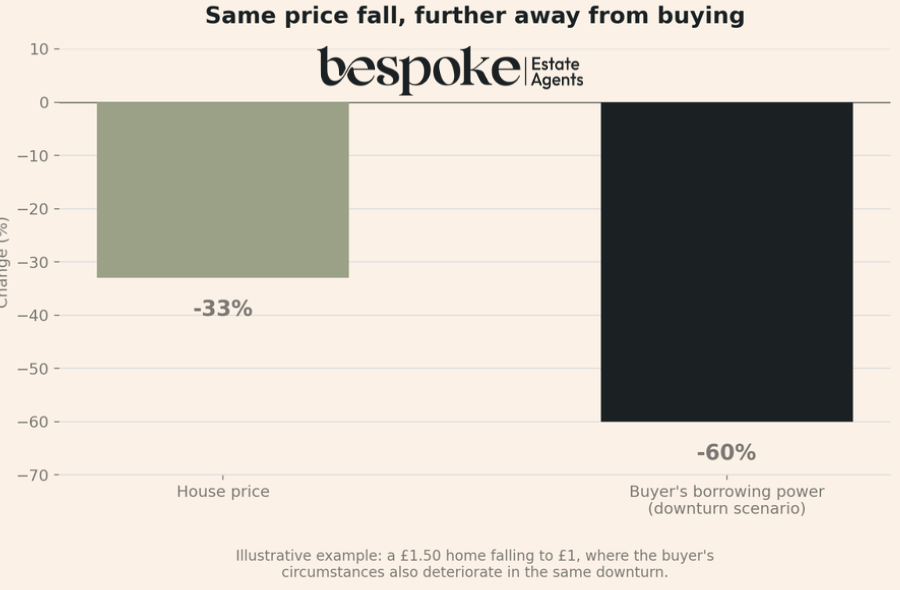
Here's perhaps the simplest way of explaining it. Imagine something costs £1.50.
You have £1.
I have £5.
You can't afford it. I can afford three. Now imagine the price crashes to £1. Great news for you, surely?
Except imagine the economic conditions that caused that crash have also cost you your job, cut your hours or made your bank unwilling to lend to you.
Your £1 has become 40p.
The thing you wanted has become considerably cheaper.
And you're further away from being able to buy it.
Meanwhile, I've still got my £5. I can now buy five.
That's the uncomfortable thing about falling asset prices during an economic downturn.
The price falling doesn't distribute the opportunity evenly.
In some circumstances, it can do precisely the opposite. And this is the gap that really matters.
Not simply the price of the house, but the distance between what it costs and your ability to pay for it.
A falling price only improves affordability if that distance gets smaller.
This is something estate agents perhaps don't say often enough because it can sound as though we're defending high house prices.
I'm not.
I'm talking about the difference between being able to see a bargain and being able to act on one. Imagine a £600,000 family home in Reading falls to £450,000.
That's a huge £150,000 reduction.
For someone who's just lost their job, had their mortgage affordability reassessed or been told by the bank that they now need a larger deposit, the £150,000 discount is largely theoretical.
They can't act on a price they can't finance.
Now consider someone sitting on £1 million of available capital whose financial circumstances haven't materially changed.
They see exactly the same house and exactly the same economic crisis. But from their perspective, it's simply:
£150,000 off.
Lending matters enormously in determining who can take advantage of opportunities in a weaker property market.
A 2025 Bank of England working paper examining a specific adverse shock affecting high-rise properties found that mortgage originations declined following the shock, with the sharpest contraction among first-time buyers. The researchers also highlighted the role of cash buyers in dampening the overall effect.
That isn't evidence that every housing downturn will behave identically, but it demonstrates something important: lower property prices don't automatically mean equal access to those properties.
A renter with a secure job, a saved deposit and a lender still willing to offer a mortgage may genuinely benefit from lower prices.
But that's a narrower group than the headline price fall suggests.
The distinction also matters between wealthy individuals and institutions. A cash-rich household may buy one home, perhaps to live in or rent out. An institutional investor, fund or corporate landlord may be able to acquire multiple properties, particularly where sellers need to sell quickly.
A housing crash doesn't automatically transfer homes from the wealthy to people currently priced out.
Under the wrong economic circumstances, it can transfer opportunities towards people who already have capital.
There's another side to falling prices that gets overlooked.
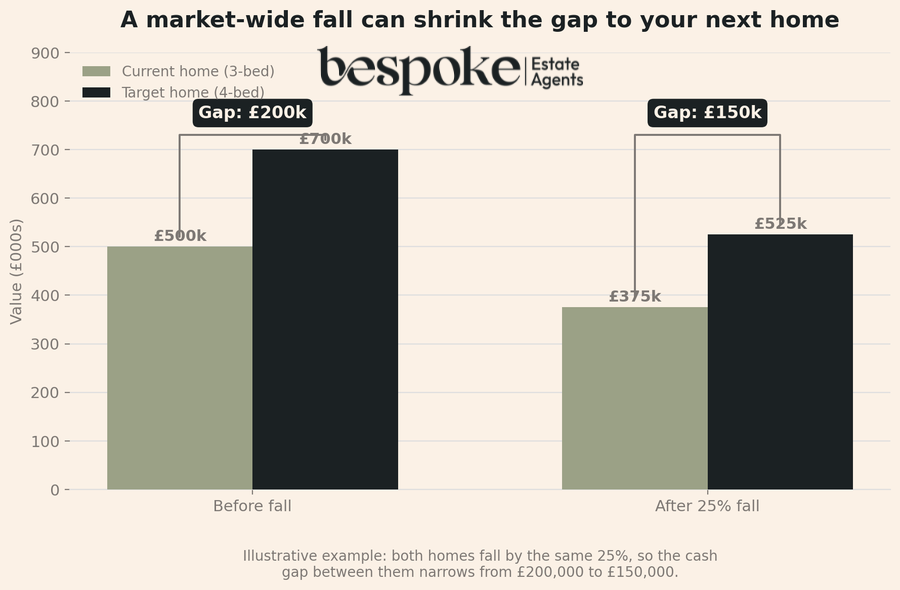
Imagine a family owns a £500,000 three-bedroom house and wants to move to a four-bedroom home worth £700,000.
Their gap is £200,000.
Now imagine the whole market falls by 25%. Their home is worth £375,000.
The house they want is now worth £525,000. They've "lost" £125,000 on their house.
But something interesting has happened.
The gap to their next home has actually fallen from £200,000 to £150,000.
On paper, the crash has made their move cheaper.
Yet that doesn't necessarily mean they'll move.
If they've only recently bought, falling prices may have eaten into their equity. Their lender may be less willing to advance the money. Their employment may feel less secure.
Or they may simply look at what their home used to be worth and refuse to accept what feels like a £125,000 loss.
This is one of the strangest features of a falling market:
The maths can say move, while confidence says stay.
When enough people make that decision, transaction numbers fall and fewer homes come to market.
Once again, the headline house price only tells us part of the story.
This is also why a single average house price rarely tells us enough about the Reading property market. My analysis of 45,802 completed sales across RG1, RG2, RG4 and RG6 found that the historic price difference between three-bedroom homes and properties with four bedrooms or more was 47.7%. Different sections of the market can behave very differently, even within the same town. You can explore the full figures in Reading House Prices by Bedroom: Where Is the Biggest Jump on the Property Ladder?.
There's another problem with celebrating falling house prices. Most people don't buy houses with cash.
They buy them with mortgages.
And that means the price of the house is only one part of what it costs to own it.
A substantial fall in property prices accompanied by falling interest rates could genuinely transform affordability.
A substantial fall accompanied by sharply rising mortgage rates could do the opposite. We saw a version of this after interest rates began rising in 2022.
Property prices softened, but that didn't necessarily make life easier for buyers because the cost of borrowing had risen dramatically.
A cheaper house with a much more expensive mortgage isn't necessarily more affordable. Again:
Cheaper and affordable are not the same thing. Buyers don't live with the asking price every month. They live with the mortgage payment.
The events of early September 2026 have made that point particularly clearly.
UK government borrowing costs rose sharply during a global bond-market sell-off, driven partly by renewed inflation concerns and higher energy prices. That movement fed into the swap rates used by lenders when pricing fixed-rate mortgages. Five-year swap rates reached their highest level since October 2023, and mortgage brokers warned that lenders were likely to begin repricing fixed deals. At least one lender had already announced an increase.
Bank Rate had not changed. The advertised prices of homes had not suddenly changed either. Yet the likely monthly cost of financing those homes had increased.
That is why judging the housing market by asking prices alone can be so misleading. A buyer can wake up to exactly the same selection of homes at exactly the same prices, but find that the mortgage required to purchase one has become more expensive.
It is equally important not to confuse the average asking price of newly listed homes with the prices achieved by properties that actually complete. I explored that distinction separately in Reading Asking Prices vs Sold Prices 2026: The 7.4% Gap.
The reverse is also true. If funding costs fall, mortgage affordability can improve before sellers reduce their asking prices.
House prices matter, of course. But they are only one moving part in a much larger affordability equation.
This is where the conversation gets much bigger than house prices.
Britain is predominantly a service economy, which makes the potential effect of AI particularly interesting.
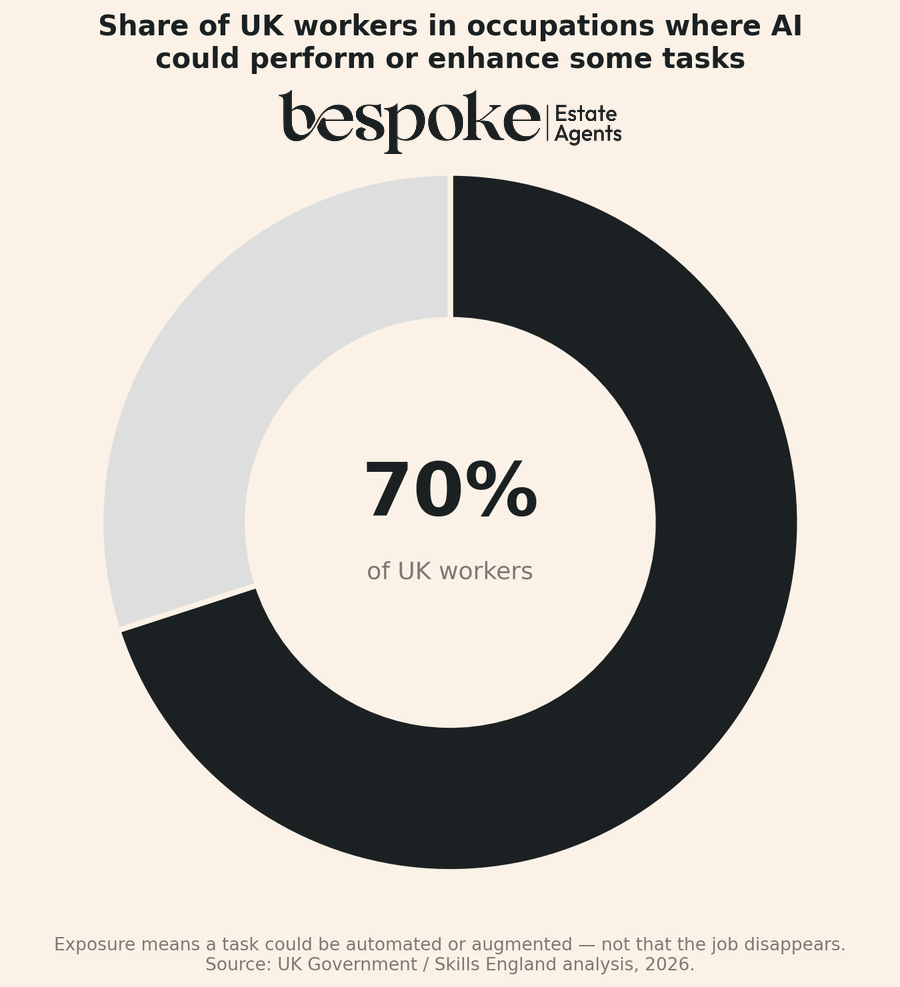
Government analysis published in 2026 estimated that around 70% of UK workers are in occupations containing tasks that AI could potentially perform or enhance.
That does not mean 70% of jobs will disappear.
The Government itself stresses that AI exposure can mean either automation or augmentation and that estimates of its employment impact remain uncertain.
But it gives us an indication of the scale of the change potentially coming.
The Bank of England is already hearing from businesses that AI is allowing some companies to increase output without a corresponding increase in employment and, in some cases, reduce staffing requirements.
Its July 2026 report specifically highlighted reduced demand for some entry-level and junior roles, including administrative work and basic analysis. Some professional-services businesses also reported reduced graduate recruitment and lower demand for junior staff.
The Bank's latest survey of businesses is equally interesting.
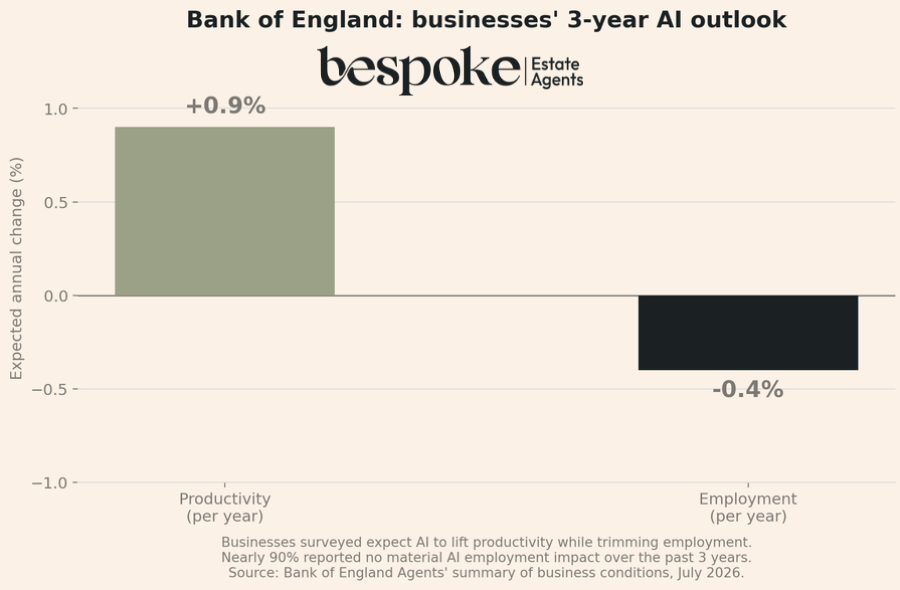
Over the next three years, respondents expect AI to increase productivity by around 0.9% per year, while reducing employment by around 0.4% per year.
Those numbers remain highly uncertain. Nearly 90% of businesses surveyed reported no material impact from AI on their employment over the previous three years, and the Bank notes that new businesses and jobs may offset some future employment effects.
But the possibility raises an important question.
What happens if businesses become considerably more productive, but ordinary households don't receive a corresponding improvement in wages, working hours or employment opportunities?
The economy can theoretically become richer while some of the people living in it feel poorer. And there's a direct connection to housing.
If AI reduces demand for junior professional, administrative and other early-career roles, many of the people affected could be the same people trying to save their first deposit or establish the income needed to qualify for a mortgage.
If a future housing downturn were caused partly by that kind of economic disruption, it wouldn't necessarily lower the ladder for them.
It could remove the ladder they were climbing.
That's where AI and housing unexpectedly meet.
For most ordinary households, wealth comes primarily from working. You earn a salary.
You save a deposit.
You borrow against your future income. You buy a house.
You gradually repay the mortgage and build equity.
Your income is what gives you access to the asset in the first place.
But someone who already owns substantial assets is in a very different position. They don't necessarily need next month's salary to buy.
So imagine an economy in which technology dramatically improves productivity but also places downward pressure on some employment and wages.
Then imagine asset prices falling at the same time.
For the household dependent upon earned income, that's potentially terrible news.
For someone with substantial existing capital, falling asset prices can represent an opportunity.
The rich don't necessarily need house prices to rise to become richer.
If they have the capital available, cheaper assets can allow them to acquire more of them.
And that's the part of the "houses need to become cheaper" argument that deserves considerably more thought.
There is obviously a generational dimension.
Older households are more likely to own property outright or have substantial equity, while younger households are more likely to rent or have recently bought using a larger mortgage.
But it would be far too simplistic to say older homeowners win from a crash and younger people lose.
Many older homeowners are asset-rich but cash-poor.
Their house may represent the majority of everything they've accumulated during their working lives.
Someone planning to downsize could see a significant chunk of that wealth disappear in a crash.
Likewise, an existing homeowner with a large mortgage could fall into negative equity and become unable to move for work, family or financial reasons.
The dividing line isn't simply age.
It's who owns assets, who owes debt, who has available capital and who still has secure income.
Those four things determine who has choices when an economy turns down.
No.
That's not the argument at all.
The alternative to unaffordable housing isn't a housing crash.
It's allowing incomes to catch up with house prices while increasing housing supply and keeping the cost of borrowing manageable.
As someone who spends every working day talking to buyers and sellers across Reading, I can see perfectly well the problems created when property prices run too far ahead of incomes.
But I don't believe a housing crash is something we should wish for either. The desirable outcome is actually rather boring.
Stable or slowly rising house prices. Rising real wages.
Sensible mortgage costs. More homes being built.
If wages rise faster than property prices for a sustained period, housing gradually becomes more affordable without requiring a dramatic collapse in property values.
Getting there requires more than hoping house prices somehow correct themselves. It means building more homes in places where people actually want to live.
It means delivering the infrastructure needed alongside them.
It means an economy capable of delivering genuine wage growth.
And it means maintaining responsible access to mortgage finance so ordinary buyers aren't locked out whenever economic conditions become difficult.
Over time, wages catching up with property prices, mortgage costs remaining manageable and housing supply expanding would make housing genuinely more affordable.
It won't generate many dramatic newspaper headlines. But it might actually work.
We have become obsessed with whether house prices are going up or down. Perhaps that's the wrong measure.
A falling house price isn't necessarily an improvement in affordability.
And a homeowner seeing the nominal value of their property fall isn't necessarily worse placed to make their next move.
What really matters is whether the gap between the home you want and your ability to pay for it is getting bigger or smaller.
That incorporates the price.
But it also incorporates your income, your deposit, your equity, the cost of borrowing and whether a lender is prepared to lend to you in the first place.
That's a much more meaningful definition of affordability than an arrow next to the latest house price index.
The housing debate usually asks:
Do house prices need to fall?
Perhaps the better question is:
If they do, who still has their pound?
Because sometimes the £1.50 house becoming £1 is fantastic news.
But only if you've still got your pound.
Not automatically. It depends on why prices have fallen.
Lower prices caused by increased housing supply alongside rising wages could genuinely improve affordability. A fall caused by recession, unemployment or restricted mortgage lending could leave some buyers further away from purchasing because their income, deposit or borrowing capacity has deteriorated at the same time.
Some first-time buyers with secure employment, saved deposits and continued access to mortgage finance could benefit substantially from lower prices.
The point is that a fall doesn't automatically help everyone currently priced out.
There isn't one group that always benefits.
Buyers with secure finances and substantial available capital are generally better placed to take advantage of falling prices.
That can include cash buyers, wealthy individuals and institutional investors who aren't as dependent upon mortgage finance.
At the same time, existing homeowners with substantial debts can face negative equity, while buyers dependent upon high loan-to-value mortgages may find lenders become more cautious precisely when prices appear most attractive.
Yes.
If the whole market falls by roughly the same percentage, the cash gap between a cheaper home and a more expensive one can shrink.
For example, the difference between £500,000 and £700,000 is £200,000.
If both fall by 25%, they become £375,000 and £525,000, reducing the gap to £150,000.
Whether the homeowner can actually take advantage depends upon their equity, mortgage position, income and confidence.
The monthly payment depends on both the amount borrowed and the interest rate. A lower purchase price can therefore be outweighed by higher mortgage rates.
Affordability should be judged using the deposit, loan size, interest rate, mortgage term and monthly payment rather than the property price alone.
Probably neither a boom nor a crash.
Stable or modestly rising house prices alongside real wage growth, manageable borrowing costs and greater housing supply would allow affordability to improve gradually without the economic disruption associated with a sharp fall.
AI doesn't directly determine house prices. The connection is employment and income.
If AI improves productivity while changing demand for certain jobs, the way those productivity gains are distributed will matter.
If some of the people affected are younger or early-career workers trying to save deposits and establish sufficient income for a mortgage, economic disruption could make buying harder even if house prices fall.
Not necessarily.
What ultimately matters is the relationship between property prices, household incomes and the cost of borrowing.
Housing can become more affordable because prices fall, because wages rise faster than prices, because mortgage costs fall, or through a combination of all three.
A gradual improvement in that relationship is likely to be considerably less painful than affordability being restored through an economic crash.
If you are considering selling a home in Reading, understanding its value is only one part of the decision. Pricing, timing, mortgage costs and the gap to your next home all matter.
I would be happy to talk through the complete picture and provide clear, evidence-led advice, without pressure or obligation.
Arrange your Reading property valuation
Mark Heneghan MNAEA is the founder of Bespoke Estate Agents and has nearly 30 years' experience in the property industry. He advises buyers and sellers across Reading, Earley, Lower Earley and the surrounding area.
Bank of England, Your voice 2026: insights from the Bank of England's outreach programmes, including its April 2025 Reading Citizens' Panel.
Bank of England Staff Working Paper No. 1,111, The anatomy of a shock to residential real estate: the role of lending, January 2025.
Skills England, Annual Skills Report 2026, Chapter 3: Accelerating adoption of AI.
Bank of England, Monetary Policy Report, July 2026.
Bank of England, Agents' summary of business conditions, July 2026.
Financial Times, UK mortgage borrowers urged to lock in deals before rates rise, 3 September 2026.
The Guardian, UK mortgage borrowers brace for rate jump amid global bond sell-off, 3 September 2026.