
Are Reading Homeowners Taking a 7.4% Hit on Their Asking Price?
By Mark Heneghan MNAEA, Founder and Director of Bespoke Estate Agents
So far in 2026, the average asking price of homes coming onto the market in Reading has been £464,400, while the average price of properties completing has been £432,400.
That means the average asking price is 7.4% higher than the average completed sale price.
But does this mean Reading homeowners are accepting 7.4% less than their asking price?
No. The figures tell us something rather different, and arguably more important, about the Reading property market.
Reading Asking Prices Versus Sold Prices: The Short Answer
The 7.4% difference does not mean Reading house prices have fallen by 7.4%. It also does not mean the average homeowner is reducing their asking price by that amount.
The two figures measure different groups of properties:
All the Reading properties coming onto the market, whether they subsequently sell or not
The Reading properties that successfully exchange contracts and complete
The completed properties are only a proportion of all the homes originally placed on the market.
The gap therefore tells us something about the types and values of properties that successfully sell, rather than the average amount negotiated from an individual seller’s asking price.
Put simply:
This is about what sells versus what remains on the market unsold.
About the Reading Property Market Data
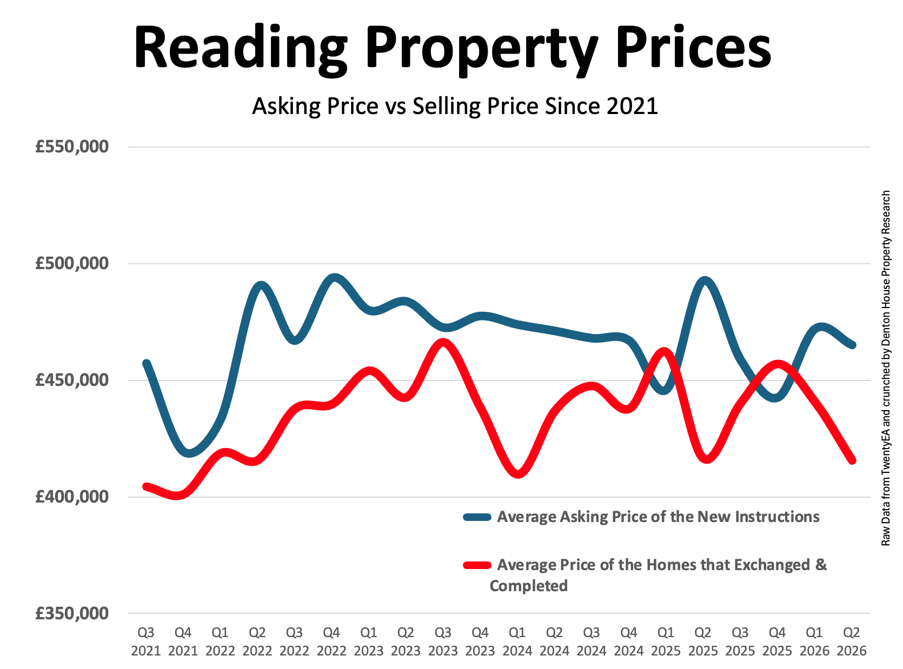
Average asking prices compared with completed sale prices in Reading. Raw data supplied by TwentyEA and analysed by Denton House Property Research.
The figures cover the RG1, RG2, RG4 and RG6 postcode districts, representing the wider Reading property market rather than only the Reading Borough Council administrative area.
This includes Reading town centre, Whitley, Shinfield, Caversham, Earley and Lower Earley.
This is why the average prices in this analysis are higher than the official ONS average house price for Reading. The ONS figure is based specifically on properties within the Reading local authority boundary, whereas this analysis includes surrounding areas that people commonly regard as part of Reading but which fall under different local authorities.
Both figures can be correct because they cover different geographical areas and different mixes of property.
In this analysis, “asking price” means the average asking price of new properties coming onto the market. “Sale price” means the average price of properties that exchanged contracts and completed.
Are Reading House Prices Falling in 2026?
The 7.4% gap is not evidence that Reading house prices have suddenly fallen or that the local property market is experiencing a crash.
Looking back over the past five years, there has consistently been a difference between the average asking price of Reading properties coming onto the market and the average price of homes completing:
2021: 8.8%
2022: 10.1%
2023: 6.3%
2024: 8.6%
2025: 3.6%
2026 so far: 7.4%
In 2021, a market widely remembered as booming, the average asking price in Reading was £438,300, compared with an average completed sale price of £402,700. That represented a gap of 8.8%, which was wider than the difference recorded so far in 2026.
The current figure is therefore not an isolated event. It reflects a pattern that has existed through rising, falling and relatively stable property markets.
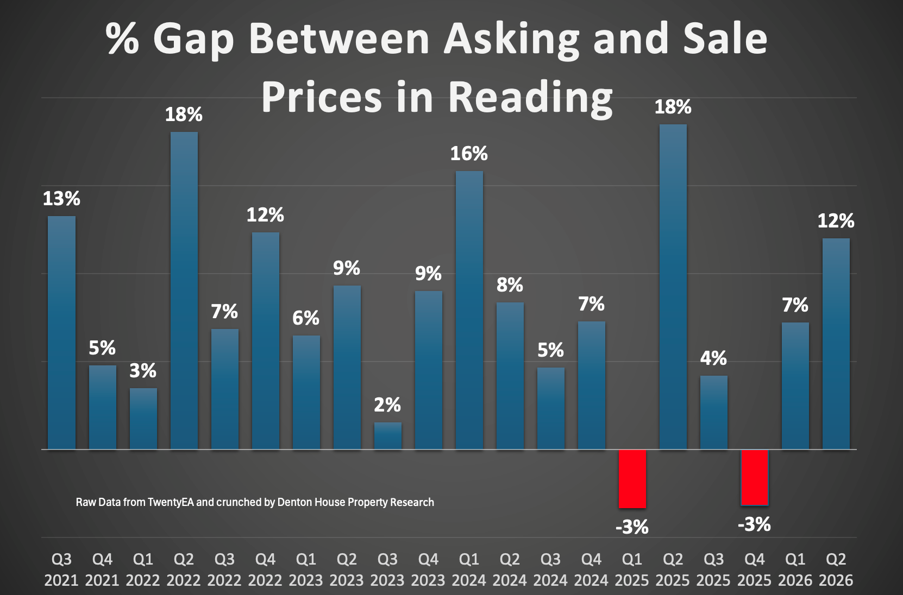
Quarterly percentage difference between average asking and completed sale prices in Reading, Q3 2021 to Q2 2026. Raw data supplied by TwentyEA and analysed by Denton House Property Research.
Why the Gap Changes So Much
Looking at the same information quarter by quarter makes the position even clearer.
During the period analysed, the difference has been as wide as 18%. In two quarters of 2025, it became negative, meaning the average price of homes completing was slightly higher than the average asking price of new properties coming onto the market at that time.
This does not mean sellers were routinely achieving more than their individual asking prices.
It reflects changes in the mix of properties being listed and the mix of properties completing.
If the 7.4% figure measured the average reduction negotiated from individual asking prices, it would need to compare the original asking price and eventual sale price of the same properties. These figures do not do that.
When a larger number of ambitious or higher-value properties come onto the market, the gap can widen. When the properties being listed are priced closer to the level buyers are willing to pay, it can narrow or even disappear.
Higher-Priced Reading Homes Are Less Likely to Sell
Over the past five years, 23,952 properties have come onto the market across the Reading postcode districts included in this analysis. Their average asking price was £448,385.
The chance of successfully selling differed depending on whether a property was marketed above or below that figure:
Reading homes marketed below £448,385 had a 55.48% chance of selling
Reading homes marketed above £448,385 had a 44.82% chance of selling
This does not mean more expensive Reading homes cannot sell. Homes in areas such as Caversham, Earley and Lower Earley regularly sell for considerably more than the overall Reading average.
It means the margin for error becomes smaller as you move further up the price range.
At the middle and upper end of the Reading property market, the asking price, presentation and marketing strategy must all work together.
Testing the market at an ambitious price can result in a home losing its most valuable period of exposure without securing a buyer. Once that initial opportunity has passed, it can be extremely difficult to recreate the same sense of freshness and urgency.
How Quickly Should a House in Reading Sell?
One of the most revealing statistics for Reading homeowners is the relationship between how quickly a buyer is found and whether the sale subsequently completes.
A Reading property that agrees a sale within 25 days of coming onto the market has a 94% chance of going on to exchange contracts and complete.
That is approximately 19 out of every 20 sales.
When a Reading property takes 100 days or more to secure a buyer, its likelihood of reaching exchange and completion falls to 56%.
That is only slightly better than a one-in-two chance.
Early momentum matters. A correctly priced and properly presented home is more likely to:
Attract serious and proceedable buyers
Generate competition
Secure a stronger offer
Maintain momentum throughout the legal process
Reach exchange and completion successfully
A property that remains on Rightmove and Zoopla for several months can quickly begin to look stale.
Buyers may assume something is wrong with it, even when there is nothing wrong with the property itself. Interest declines, price reductions often follow and the homeowner can eventually achieve less than might have been possible with the right strategy from the outset.
Realistic Pricing Does Not Mean Undervaluing Your Home
Pricing realistically is not the same as pricing cheaply.
The objective should always be to achieve the best price the market will support. However, there is an important difference between maximising the value of your home and advertising it at a figure the evidence cannot justify.
A sensible and defensible asking price should consider:
Recent comparable properties that have actually sold
Properties currently competing for the same buyers
Local demand for your type of property
The condition and presentation of your home
Your preferred timeframe for moving
The marketing and launch strategy being used
Looking only at the asking prices of other homes can be misleading.
Some of those properties may never sell at their advertised prices. Others may remain available for months before being reduced or withdrawn from the market altogether.
Completed sales and recently agreed transactions provide a much clearer indication of what buyers are genuinely prepared to pay.
What This Means If You Are Selling a Property in Reading
A significant proportion of Reading homes placed on the market in 2026 will not find a buyer, and unrealistic pricing is often one of the main reasons.
That is not necessarily because they are poor properties or because the Reading property market is broken.
In many cases, sellers are being encouraged to price for the market they would like to have rather than the market that actually exists.
There are three important points for Reading homeowners to consider:
If your home is being placed at the very top of its potential price range, your estate agent should be able to justify the recommendation with genuine evidence. That means comparable completed sales, current competition and a clear explanation of local buyer demand.
Choose your estate agent based on their strategy and ability to deliver the best result, not simply on who suggests the highest asking price. Giving the highest valuation is easy. Delivering that price is considerably harder.
Think carefully before signing a lengthy sole agency agreement. A long tie-in can protect the estate agent far more than it protects the homeowner, particularly if the original pricing and marketing strategy proves unsuccessful.
The objective is not simply to place your Reading home on the market.
It is to create the interest, momentum and buyer confidence needed to sell successfully and move on to the next chapter of your life.
A More Considered Approach to Selling Your Reading Home
This analysis reflects the approach I take at Bespoke Estate Agents.
Every valuation I provide is evidence-led and based on completed sales, current competition and genuine local demand. I will never recommend an inflated asking price simply to win an instruction.
Every property launch is carefully planned so that the photography, presentation, description, pricing and marketing are working together from the beginning.
You also deal directly with me throughout the process, from the initial valuation until your sale completes.
After more than 30 years selling homes in Reading and the surrounding areas, I would rather give you honest advice at the beginning than have to explain an avoidable price reduction several months later.
Frequently Asked Questions About Reading Asking and Sold Prices
Are Reading homeowners accepting 7.4% below their asking price?
No. The 7.4% figure compares the average asking price of all new properties coming onto the market with the average price of homes completing. It does not compare the original asking price and eventual sale price of the same properties.
Are Reading house prices falling in 2026?
The 7.4% difference is not evidence that Reading house prices have fallen by 7.4%. Similar gaps have appeared throughout the past five years, including during stronger property markets. It mainly reflects the difference between the properties being listed and those successfully completing.
What is the average asking price of a Reading home in 2026?
Across the RG1, RG2, RG4 and RG6 postcode districts, the average asking price of homes coming onto the market so far in 2026 has been £464,400.
What is the average completed sale price in Reading in 2026?
The average completed sale price across the Reading postcode districts analysed has been £432,400 so far in 2026.
Why are these figures higher than the ONS average house price for Reading?
The ONS figure covers properties within the Reading Borough Council boundary. This analysis covers the wider Reading property market across RG1, RG2, RG4 and RG6, including areas such as Earley, Lower Earley and Shinfield. The two datasets therefore cover different geographical areas and different mixes of property.
How quickly should a property in Reading sell?
A Reading property agreeing a sale within 25 days has a 94% chance of subsequently exchanging contracts and completing. When a property takes 100 days or more to secure a buyer, that likelihood falls to 56%.
Should I choose the estate agent who gives me the highest valuation?
Not automatically. Ask each estate agent to support their recommendation with comparable completed sales, current competition and evidence of buyer demand. The best asking price is one that maximises your result while still encouraging serious buyers to act.
Does realistic pricing mean selling my home cheaply?
No. Realistic pricing means positioning your home to attract strong interest and achieve the best price supported by the market. An inflated asking price can reduce early interest and eventually result in a lower sale price after the property becomes stale.
Thinking of Selling Your Reading Home?
If you are considering selling in Reading, Earley, Lower Earley, Shinfield or the surrounding villages, I can provide an honest, evidence-led assessment of your property and the strategy most likely to achieve the best possible result.
There is no pressure and no inflated valuation designed simply to secure your instruction.
Just clear local advice based on the Reading property market as it is today.
Book your personal, evidence-led property valuation with Bespoke Estate Agents.